In "Viewers Make Meaning", by Sturken and Cartwright, a large variety of topics are covered. The first topic that caught my eye was the discussion of how ad's target certain audiences. It would make more sense to aim towards the largest audience possible right? This made me think of some ads that I have seen that feature an ambiguous model in that it is not fully possible to determine one particular race that she appeals to. Ad companies do this to appeal to a multitude of audiences. Although this may be the case, one example that comes to my mind is the Furman brochure. We feature a catalogue of many different races shown doing various activities, while in reality, Furman is a campus that has a majority of caucasian students. While the school is trying to bring in more diversity, I think that this is also a form of false advertising. Yes, it appeals to a larger community of possible students, but it is also not a completely true ad. Should Furman change this? Why or why not? How would this affect future students looking at the school?
Another topic that caught my eye was when Sturken and Cartwright said that "to feel touched by a mass image is to harbor a mistaken understanding of oneself as the individual for whom the image's meaning is personally intended" (51). I feel as though many people can relate to this statement when music is considered. Personally, whenever I listen to a song that I like, the words speak to me and make me think that the song was made especially for my situation. A great example would be Taylor Swift and her songs. Many young girls relate their lives to her songs and believe that their situation fits her songs perfectly. When I hear songs that I personally relate to in an elevator or a store, it opens my eyes to how public music truly is. The same goes for art. Everyone takes a different meaning from each piece.
One last topic that I would like to mention is that meanings that are supposed to be presented are not always the ones taken. According to Sturken and Cartwright "viewers may make meanings that are not intended or anticipated by its producers, and that viewers are active agents in the production of meaning" (55). I related this immediately to an article that I was referred to by Facebook. It talks about how there are some websites that have unintentionally humiliated themselves by their website's name. One particular example is speedofart.com which is for the website called Speed Of Art, but people can interpret Speed O Fart from it. Should certain advertisers include their specific meaning in their ads to avoid things like this? Should they leave it up to interpretation? Why or why not?
In "Images, Power, and Politics" by Sturken and Cartwright, it is discussed how images play a large role in our lives. Specifically, Sturken and Cartwright point out that "a single image can serve a multitude of purposes, appear in a range of settings, and mean different things to different people" (9). They go on to give many examples and discuss a few in depth.
In one of the first images that they share, they talk about how the photographer used the subjects' raw emotions to get the reaction that he wanted. This reminded me of several slaughterhouse videos and images that were shared with me over the summer while I was doing research into how animals were treated in their farms. I am not going to post images of these things here, but I do believe that they were posted initially to get reactions from the public. These images were used to spark action in people instead of being a pure entertainment image, like so many others. The authors state "the power of the photograph to provide evidence of violence and injustice is coupled with the photograph's power to shock and horrify" (11). Do you think that photos have this power? Should they be used primarily for this or entertainment? Why? Why not?
Later on, Sturken and Cartwright point out that although we know that photos have the option to be altered, we usually have "the shared belief that photographs are objective or truthful records of events" (18). The most obvious example that came to my mind was that of models and fashion. Magazine covers and photo shoots of celebrities are always altered. America has especially looked to these images, which many people know are altered, to attain a standard for themselves. This ideal is highly unrealistic, and it causes many young girls to look to eating disorders to attain this extremely skinny appearance. This is another example of an action that is sparked by an image.
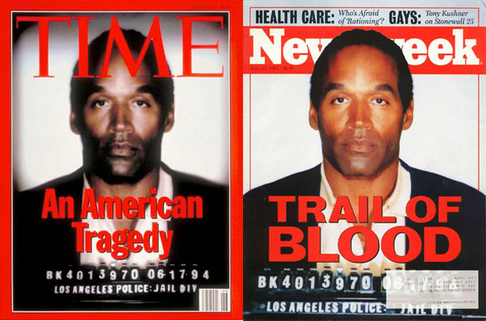
It is also mentioned that during the OJ Simpson case, both Time magazine and Newsweek reproduced Simpson's mugshot as their cover. Newsweek placed an unedited mugshot on their cover while Time "heightened the contrast and darkened Simpson's skin tone" (25). I thought it was particularly interesting that Time would not allow the authors to reproduce the cover image in their book, while Newsweek did. To me, that seems like they are realizing that they should not have done that, but it has taken them a while to figure that out. What do you think? Should magazines be allowed to photoshop their covers? If so, should they have to declare it in their magazine? If not, why not? What benefits and costs would that have to the public? Towards the end, the authors discussed how a piece of art's value is "determined by economic and cultural factors" (34). They then go on to discuss Van Gogh's work as well as Pollock's. I thought it was incredibly interesting that they questioned why Van Gogh's paintings were in 1991, while when he was still alive, he never made any money off of them. The people during his time did not want to see his art because it was not the style back then. Today, however, it is a different story.


.jpg)